Thursday, February 03, 2005

Not just socially insecure; we're socially retarded

Aside from the fact that the President announced yet another way to enshrine wealth as a legacy (pass on the money in your account? Jefferson, what?), it appears that all this "you get to keep it all for yourself, the no good government has to keep its dirty hands off" stuff just isn't true at all. An article in today's Post runs through the plan as described by another headless horseman ("senior administration official"). This is a very good article on what the changes would actually look like.

The Numbers:

Under the system, the gains may be minimal. The Social Security Administration, in projecting benefits under a partially privatized system, assumes a 4.6 percent rate of return above inflation. The Congressional Budget Office, Capitol Hill's official scorekeeper, assumes 3.3 percent gains.


The Catch:

[Under the convoluted rules of the new plan (read the article for more),] with a 4.6 percent average gain over inflation, the government keeps more than 70 percent. With the CBO's 3.3 percent rate, the worker is left with nothing but the guaranteed benefit.


The really scary part:

If instead, workers decide to stay in the traditional system, they would receive the benefit that Social Security could pay out of payroll taxes still flowing into the system, the official said. Which option would be best is still unclear because the White House has yet to propose how severely guaranteed benefits would be cut for those with individual accounts.


This creates the same problem as Health Savings Accounts: young (mostly healthy) people move out of these programs, leaving the chronically ill or chronically poor to fend for themselves in a program who's coffers have run dry and they bear the burden of risk, even though they are already among the most vulnerable segments of the population.

Paul Krugman had a great Op-Ed about why the math is wrong. There's an inconsistency in the numbers he uses and the ones the Post article use (he says the SSA uses a 6.5 or 7% return above inflation number, and the Weisman article says 4.6. Honestly, I don't have the faintest which is right), but article itself is good. To summarize: All evidence points to the fact that partially privatizing Social Security appears to offer no discernable benefit above and beyond the current program, while greatly increasing risk, to the tune of a trillion dollars. If the economy continues growing with no contractions, it might offer a slight bonus to some. Even in this rosy happy land of money tree orchards, the government is still going to be taking a huge chunk of the gain away. And -- voila! --


p.s.: Anyone else see Dick Chaney lose it last night during the state of the union, when Bush said that the Administration was "open to all suggestions" about how to fix social security? He started laughing so hard he had to move his head off camera. I mean, please.

Guarding the Tomb of the Unknown Soldier

This is just motherf*cking crazy:

For a person to apply for guard duty at the tomb, he must be between 5' 10" and 6' 2" tall and his waist size cannot exceed 30." Other requirements of the Guard: They must commit 2 years of life to guard the tomb, live in a barracks under the tomb, and cannot drink any alcohol on or off duty for the rest of their lives. They cannot swear in public for the rest of their lives and cannot disgrace the uniform {fighting} or the tomb in any way. After two years, the guard is given a wreath pin that is worn on their lapel signifying they served as guard of the tomb. There are only 400 presently worn. The guard must obey these rules for the rest of their lives or give up the wreath pin.

The shoes are specially made with very thick soles to keep the heat and cold from their feet. There are metal heel plates that extend to the top of the shoe in order to make the loud click as they come to a halt. There are no wrinkles, folds or lint on the uniform. Guards dress for duty in front of a full-length mirror.

The first six months of duty a guard cannot talk to anyone, nor watch TV. All off duty time is spent studying the 175 notable people laid to rest in Arlington National Cemetery. A guard must memorize who they are and where they are interred. Among the notables are: President Taft, Joe E. Lewis {the boxer} and Medal of Honor winner Audie Murphy, {the most decorated soldier of WWII} of Hollywood fame.

Every guard spends five hours a day getting his uniforms ready for guard duty.


Joe Lewis is buried at Arlington!?

Wednesday, November 24, 2004

Bank Account for Slackers, Bums, and Hosers Overflowing

Would that we could live next door to a larger, richer, more powerful, more agressive neighbor who propped up our economy and did all of the offensive (but sometimes necessary) things that make other countries feel ire. Then we, too, might have a $46 billion surplus in our welfare coffers. Imagine having half of that $80 billion Iraq funding back, and earmarked for the unemployed... thanksgiving, indeed.

Then again, it looks like Canada is making a significant strategic push to secure the Artic as Canadian land (currently, and astoundingly, the U.S. does not recognize Canadian sovereignty in that region) by turning their northern territories into proper provinces. Strategic? (C'mon, you might ask.) Answer: water. If the world becomes water poor sometime in the next century, as is predicted, the large stores of fresh water in the Artcic may become as hot a commodity as oil.

O, Canada. Even when they get geopolitical, they're still helping people stay hydrated.

Politic$

A recent article in the Christian Science Monitor discusses the emergence of so-called 527s in the state political arena. The most compelling point raised in the article:
Named for the section of the tax code that gives them tax-exempt status, 527s have no contribution or spending limits. More important, 527 contributions do not count against an individual's limit per campaign cycle. Thus, a contributor who is allowed to give only $95,000 to candidates and political committees during the biennial election cycle can donate millions to 527s à la George Soros.
As we saw with this election's spate of "issue ads" by such suspect groups as Swift Boat Veterans for Truth, the current campaign finance reform does little to actually reduce the impact of cold, hard cash on an election - as the article suggests, the reform now means "candidates have deniability when negative ads crop up." If it is the case that unscrupulous interests will exploit the laws to the fullest to elect their candidate no matter what, and if the ultimate goal of reform is to reduce the influence special interests (such as corporations, labor unions, and wealthy individuals) have on the political process, what other reforms are needed?

First, we need more trains. Who is not enchanted by the idea of Harry Truman pulling into small town America, delivering a stump speech, and then chugging off to the next bastion of Americana several miles across the plain? That is to say, who is not completely baffled by the fact that both George Bush and John Kerry can each appear simultaneously in more than four noncontiguous battleground states, thanks to modern transportation technology? Perhaps the frenetic motion of national candidates reflects the size and diversity of the country or our postmodern culture and its TV commercial attention span. But I think it is reasonable to assume that a candidate who tries to pander to all places simultaneously cannot adquately pander to any single one. As political consumers, we are delivered a product as bland and generic as those champagne-colored mid-market sedans, aiming for the most common denominator, rather than our highest passions. So the first reform has to do with the pace and depth of campaigning.

Second, a moratorium on television advertising. We do not need to be sold on a candidate like we need to be sold on a box of smooth Philadelphia Cream Cheese or low-carb soda. We need to be convinced of a candidates merits and partisan advertising is rarely convincing. Instead, it only validates what one already believes and is typically without any merit whatsoever. And so we easily throw the packaged political sentiment on the junkheap of our consciousness where reside all the infomercials for electronic rotisseries and self-hair cutting systems we have ever seen. Politics becomes cheap and disposable. We need to reject the commodification of our politics, so brazenly and hideously on display this past election. And, because television ads are the overwhelming reason for such absurd campaign costs, this measure would a) cut those Madison Avenue fatcats down to size, who are making millions out of the pockets of election contributors and b) mean that campaigns are significantly cheaper. It would also blunt the influence of large corporations who talk mostly with their advertising money, and rarely by hitting the streets to talk with voters.

Third, iron-clad disclosure laws to reveal the paper trail behind so-called non-partisan political organizations. Every dollar and its provenance needs to be documented and filed in the public domain.

Constructing the Terror Lair

The emerging vernacular of the "war on terror" appears to have been shaped as much by medieval myth and history as by current political reality. Not only does the neo-conservative agenda of free marketization/democratization of the Middle East smack of a secularized Crusade (the secular characteristic of which is being steadily undermined by the administration's pandering to its conservative Christian base - see below), but a new construct, the terror lair, rings of an Inquisitorial auditorium populated by dragonf, or at leaft manticoref.

A Washington Post Express article [PDF] provides a description of an archetypal "terror lair": "Inside the building, U.S. soliders found documents, old computers and copies of the Quran. Several bodies also were found." The first two, documents and computers, serve to establish the site as a "command center" for terrorist operations - in this case, a headquarters of Abu Musab al-Zarqawi, suspected of coordinating major parts of the insurgency in Iraq. By themselves, documents and computers are rather generic descriptors of a business environment. But they buttress the first key principle of the contemporary understanding of global terrorism: it is highly coordinated and organized and the war against it is fought as much in a cubicle at Langley as in the streets of Fallujah. The third characteristic, copies of the Quran, supports the second key principle of our (meaning American) understanding of global terrorism: it has its roots in Islamic fundamentalism. One can only assume that the bodies exist to credibly identify the site as a "terrifying" place; alternately, they may be stocking the larder of the aforementioned mythical beasts.

Dispensing with office materials and dead insurgents, the most salient and troubling aspect of the terror lair is its construction around "copies of the Quran." Deconstructing the term "terror lair":

terror: noun. a) fear induced with the intention of influencing political decisions. Examples: hostage taking and execution, suicide bombings of civilians, manipulation of color-coded terrorist alert system; b) utter fright produced by experiencing the impossible or uncanny. Examples: watching yourself sleeping, being eaten by dragons and/or manticores.

lair: noun. interior location, often dank and poorly lit, where congregate or inhabit evildoers/villainous creatures. Examples: Smaug's castle in The Hobbit, Dick Cheney's undisclosed bunker, Osama bin Laden's cave.

If this terminology is being deployed in the War on Terror, it can only be to the end of demonizing the practice of Islam, which by many, not only neo-cons, is perceived as a medieval relic and the major stumbling block to democratizing in the Middle East. Consequently, the archaic "terror lair" integrates with the conception of the Middle East as backwards and with the image of terrorists as subhuman. Whether or not these characterizations are justified, what concerns us is that the ubiquitous association of the holy text of Islam with terrorists/insurgents imbues the Quran with sinister, totemic power - a gross and insulting misunderstanding, but one that underscores the "holy war" character of the war on terror/the Middle East. Finding the Quran whereever there are terrorists justifies the assault, with both arms and propaganda, on Islam. The Quran, as a physical object, becomes a trophy of the war enterprise - confiscating copies is akin to securing a cache of weapons. Perhaps the parallel is more salient than at first glance - like a Kalashnikov, the Quran is perceived by many in the United States as dangerous, as something that needs to be forcibly taken from Iraqis for their own good, for freedom to truly be on the march. Our conception of the terrorist is a person with a bomb in one hand and a holy book in the other. I would like to propose that this applies as much to abortion clinic bombers as to Iraqi insurgents.

Monday, November 22, 2004

President Plots with Menacing Baby Disguised as Duck

Sic'em babyduck, sic'em!


Pardon Pirates

Number of turkeys George W. Bush has pardoned since taking office: 2.
Number of death row inmates he pardoned as the Governor of Texas: 1.
Number of prisoners executed while he was Governor: 158.

An interesting article about the role of Alberto Gonzales, our new Attorney General (and the pirate who made off the with booty of the Geneva Conventions), in these exectutions was published in the July/August issue of the Atlantic Monthly. It suggests that Bush made most of his decisions regarding commutation of the death sentence based on summaries of the cases written by Gonazales (his legal council at the time), and that they were mostly incomplete or biased in favor of Bush's stated preference: justice, Texas style. (Gary Graham, who was executed in July 2000 although he insisted on his innocence until the last words, called it "legal lynching," which has a certain ring, and called the death penalty "America's holocaust for black people," which doesn't. He also asked supporters to descend on Hunstville with Ak-47s to prevent the exectution, so we'd do well to take him and his judgements with a grain of salt. Frontier justice, indeed.) The article doesn't conclusively show wrongdoing (Gonzales was, in a very basic sense, just doing his job) but it does indicate a lack of compassion, a lesser crime than ... well, violating international law. But international law is largely writ with the intention of making compassionate self-interest a parmount issue in the rules of war, meaning that the failure of compassion is more concerning than Capt. Gonzales seems to imagine. Yar, matey.

John Ashcroft covered the naked statue of Justice in the Department of Justice's main hall because it was "indecent." Alberto Gonzales doesn't want to acknowledge that our judicial system makes mistakes, while simultaneously recommending the expansion of its ability to do so. That blue drape they ceremoniously draped over the Great Lady will soon be too tattered to cover much of anything.


Friday, November 19, 2004

Our Capitalism 1

Sometimes, as I pour into a styrofoam cup the poor-quality coffee that is, inexplicably, as much staple of corporate environments as the cubicle, I wonder what kind of day will it be. Will it be a CoffeeMate Hazelnut, French Vanilla, or Plain kind-of-day? Today was Hazelnut.

Monday, November 15, 2004

IE Outfoxxxed

The recent release of Firefox 1.0 has sent shockwaves through the small community of nerds that tracks this Netscape/Mozilla-based standalone browser. Techno-pundits far and wide, including in the Washington Post and the New York Times, and bloggers have endorsed the browser as not only an alternative to Microsoft's Internet Explorer, but as, quite frankly, a superior product. This release of Firefox is certain to raise awareness of the benefits of open-source software and invigorate grassroots alternatives to monopolistic corporations. But one question remains to be answered:

Will Firefox help you get more sex?

By the names alone, Firefox seems to have a definite advantage over Internet Explorer. Sleek and alliterative, Firefox suggests both the heat of passion ("fire-") and the sensuousness of a beautiful woman ("-fox"). Internet Explorer, while functional and descriptive, paradoxically conjures no sense of adventure or romance, despite its couched reference to the early 16th century navigator Domingo Vericelli. To utter "Firefox" when describing your web browsing is to speak in a language of mystery and mythology - but "Internet Explorer" can no longer be spoken except in a monotonal, robotic voice. Like robots, those who use Internet Explorer must feel devoid of meaning and emotion, from time to time.

Firefox evolved from the alpha release Firebird, who's iconography connoted the mythical phoenix, a bird who's immolation is prequel to an ashen rebirth. Many scholars have suggested that, as the release date for Mozilla Foundation's browser drew nigh, Firebird was no longer an appropriate symbolic matrix: the browser may have been born of the ashes of Netscape Navigator and Mozilla, both of which perished during the browser wars of the 1990s, but its core implementation plan was to slip below the radar of Microsoft, cultivate a following among progressive internet users, and outmaneuver the software giant when it came to browsing experience and security. Thus was born the lithe, nubile moniker Firefox.

Those who adopted Firebird, and subsequently Firefox, early on, were perhaps not the best candidates for a sustained study of the relationship between sexual activity and browsing platform. With over 90% of the market in hand, Internet Explorer was, by the numbers, bound to have adherents with more active personal lives than those who, huddled amidst empty cellophane Cheetos bags, sequestered themselves more and more in the process of programming extensions, designing customized application "skins", and eagerly scanning the web for pictures of Anna Kournikova. And yet, with the release of 1.0 and the concurrent rise of geek-chic icons like The OC's Seth Cohen, those programmers are, evidently, finding themselves flooded with more tail than they know what to do with. Scott Wizniewski, of Palo Alto, CA, responsible for the popular FireNova skin, has recently commented that fans of his work were "calling [him] up and asking for hot sex." While Wizniewski declined most of the offers, he nonetheless leaped to the top of his apartment's "Lovemeter", a whiteboard that tracks sexual encounters for each of his roommates.

Those who continue to use Internet Explorer are being dumped at an alarming rate, according to the Atlanta Sentinel, by "security-conscious" partners. "We live in a perilous age, with Islamic fundamentalism on the rise, civil liberties under attack, and the threat of terrorism, or at least terrorist alerts, everyday. I think we are observing a cultural trend toward greater security and greater control in all aspects of daily life, including web browsing," said cyber-security expert Linda Harmon.

"The general feeling is that sexual partners who use Internet Explorer may not only be infected by computer viruses," she added.

| chimeric antibodies |

Saturday, November 13, 2004

Marlboro Man: "I will bring liberty and cigarettes to Iraq."

Fallujah, Iraq - In an interview with embedded reporter John Curtis, the Marlboro Man repeated his vow to bring "liberty and cigarettes" to the fledgling Iraqi democracy. "We are in the midst of an epic battle for the hearts, minds, and lungs of this proud people," said the Man, as he drew deeply on a Red 100. "The Iraqi people want the freedom to choose, and one of those choices is to smoke fine Marlboro products." PFC Samuel Kinkead supported the Marlboro Man's sentiment: "A lot of the guys here, they don't see any action. We patrol three or four hours a day in our Humvees or Bradleys and have nothing to show for it but the dust in our boots and the dirt caked cinematically on our faces. I, for one, could not be out here winning the war on terror without my Marlboro Extra-lights."

Some, however, have questioned the efficacy of the Marlboro Man's tactics, which include airdropping cartons of cigarettes and parading scantily clad beach volleyball players through the slums of Fallujah. "I just don't think Iraq is ready for this level of freedom and democracy," said one senior administration official, who agreed to speak on condition of anonymity. "For one thing, most Iraqis continue to wear 'traditional garb' such as the imamah, hijab, and ski mask that preclude smoking. We are also relatively convinced that these cartons of cigarettes are, for the moment, fueling a black market in small arms."

He added: "Lit cigarettes are also perfect targets for snipers. Recently casualty figures in the Sunni triangle suggest that the Iraqis know this, or possibly that there are Viet Cong in their ranks."

But others are convinced that Operation Smooth Draw will be a success. "When I signed up with the Arkansas National Guard, sure I never dreamed I would be out here pulling a second eight month tour," remarked Private Joe Jenkins, of Pine Bluff. "But seeing some of these kids taking their first, grateful drag off a Marlboro menthol, and wearing a warm Marlboro motorcycle jacket, convinces me that Iraq can be a strong, healthy democracy in the Arab world." Private Jenkins then looked off into the blue distance over the battle-scarred desert, weary but reflective. Tucked into the spare ammo clip holder on his tactical vest was a half-empty pack of Marlboro Lights.

| chimeric antibodies |

Wednesday, November 10, 2004

Sexegesis

I would never deign to call myself a tight-skirt-wearing exegete, but I'm happy to let Jon do so. Since we're on the topic, and since we here at Spittoon (most obviously) embrace concision, I'd like to point out that "sexegete" is a much-needed addition to the lexicon.

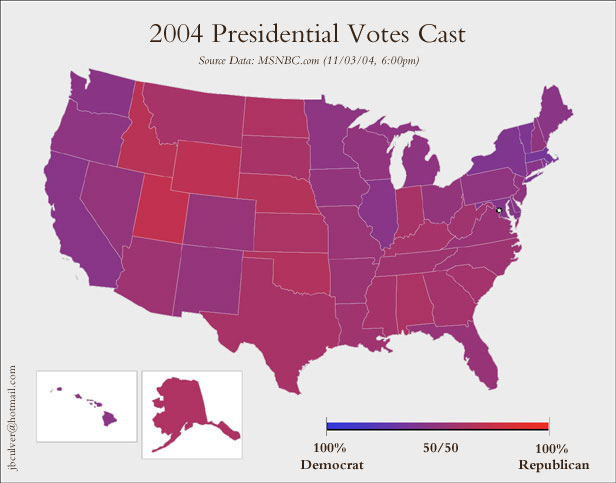
Red + Blue = Purple [rev]

Another extremely lucid exegesis of American politics by Hanna, tight-skirt-wearing exegete [below]. One point that I was pleasantly surprised by dealt with the idea of access to voters in sections of the country divided by rather narrow margins of 10-20%. Looking at this map of the recent election bears out Hanna's analysis:


If we live in a purple nation, then both parties lose in an electoral system that is safely predictable once the spread hits 15 points. But neither party has the incentive to devote time, and primarily money (even in a campaign of $600m), to a state where their voters are in the minority, even if that "minority" is 40% of a state's voters. As we see from this year's electoral maps, Republicans have an incentive to cater to heartland voters and Democrats to coastal voters, when in fact no such rural/coastal or south/north divide really exists. But those electoral pools certainly shape the policy decisions and priorities of their respective parties. So, coincident with the prospect of access to stranded voting blocs that might be gained by abolishing the electoral system, there is also the prospect of more responsive and more open-minded political parties and a fundamental re-definition of the conventional "party base." In particular, a better reflection of political and social diversity within taken-for-granted voting blocs, such as African Americans and Hispanics.
| salvage theory |

Softly Disenfranchised

The impeccable and unflappable Josh Marshall has a very good summary of the debate over the Electoral College (i.e. get rid of it with a constitutional ammendment, or keep things as they are). Marshall talks about being somewhat uncertain of his new endorsement of abolishing the EC. I'm not as smart as Josh, nor as cautious. I am both certain that I look better in tight skirts, and solidly convinced that the EC should go.

The U.S. has continually moved to expand enfranchisement, through the 16th amendment (1913, race), 19th amendment (1920, sex), 23rd amendment (D.C. residents), 24th (failure to pay taxes will not abridge the right to vote), and 26th amendment (sets voting age at 18, from 21). While abolishing the electoral college would not grant anyone the right to vote who does not already have that right, it would get rid of the “soft” disenfranchisement of hundreds of thousands of voters who do not in any meaningful way contribute to the election of government representatives because of the fact of where they live. What point is there in voting if your vote doesn’t have an impact on the outcome of elections (whether you are Republican or Democrat or Libertarian or Constitutionalitarian)?

Marshall lays out the argument for abolishing the EC pretty comprehensively and convincingly. I have a few points to add and a little analysis of what it might mean for the future of American politics.

Clearly, abolishing the EC would have a huge impact on how election politics function. California and New York would receive the bulk of attention because they have the most voters. But it wouldn’t necessarily get rid of “swing states” (or, as is more likely, “swing cities”). Attention would turn to issues important to urban voters and voters living on the borders of the country (the borders have larger concentrations of people). This, I think, would mean an increased focus on immigration and security. It would mean investment in issues like urban public schools, sprawl and transportation, and housing. It would, in some sense, deprive states of a certain amount of political capital, as they would no longer be “delivering votes” or be on the receiving end of statewide funding for important election-year projects (roads, dams, etc.). It would mean that politics get, in a certain sense, smaller – regions of states would become more important than states, and cities would be the most important political entities of all. It would also mean that the rhetorical space of politics gets bigger -- by giving third parties more sway. It might have large implications for how future presidents are chosen (municipal leaders could, potentially, supplant or equal the power the governors now have when it comes to transitioning into national politics).

The biggest argument for getting rid of the EC, in my mind, is that the popular vote more accurately reflects the will of the people. People don't necessarily vote in demographic blocs (black, white, male, female, gay, youth, poor, urban, etc.) but looking at those blocs tells us things about this country. For instance: more people are not only living in cities, but moving to them. The latino population in the States is exploding (its been a slow detonation, gaining speed over the past few decades). Tying the election of the President to the popular vote will reflect these changes and forces the hand of our Head of State by increasing his responsivness to the reality of our country and the wants of its people.

Meanwhile, the small states really do not need any more insulation than they are afforded by the composition of the Senate. Would getting rid of the EC, however, mean that large swaths of rural voters would essentially become "softly" disenfranchised in place of their urban counterparts? Well, on the surface, yes. The quick rebuttal is that "majority rules" and getting rid of the electoral college empowers more voters than it would disempower. But if you think about it, rural areas provide critical resources that urban areas can't (lumber, agriculture, oil, land (!) and therefore manufacturing [you need space to build large factories], and no small amount of human capital -- it's still rural voters who contribute the most to the military, and I don't think that will change anytime soon). Rural areas will still have critical leverage with politicians and politicians will still have to court rural voters. Practically, in fact, it means that Democrats will have access to voters in the middle of the country that they haven't had for many years. Republicans, conversely, would have access to North Eastern or urban voters. Many solidly Blue states still have 40% of voters that vote Republican. And vice versa. You can bet the parties will pay attention to those previously neglected groups.

I would actually take the enfranchisement argument one step further and suggest that Election Day should be a national holiday. The sort-of poor (not the jobless, but the people who hold down three jobs to get by) – are functionally disenfranchised because they are not able to get time off of work to vote, or if they are, they are still unable to give the time to it because of other obligations. A national holdiay wouldn’t necessarily halt the problem for service industry workers (although they tend to work hours that are not strictly 9-5 and could probably get to the polls on one end of their shift or the other). In an ideal world, Election Day would be like Christmas Day. One of two days of the year that the whole country takes a collective deep breath and thinks about things other than money - the malls closed, the banks closed, the friperies cerada. Making Election Day a holiday would have the added benefit of envigorating voters, because all patriotic national holidays now come replete with TV specials, parades, and platitudes from our elected representatives. Voting would become an issue of patriotism, and it will have been endorsed by the action of the federal government in telling us all that voting is at least as important as honoring Christopher Columbus or our war heroes.

How to Thwart the Electoral College 1

Here was the uber-right's scheme for solid state voters:

John Kerry IS going to WIN the state of [Maryland] on November 2. That's a FACT. This state is a "solid blue" state. That means that every single poll has Kerry winning without a doubt, beyond the margin of error for any poll. So what does that mean for true conservatives -- hard working, patriotic Americans -- like you and I? It means we live in a state where our vote will be a WASTED vote... if we vote for George W. Bush.

Don't get me wrong. I do NOT want John Kerry to win this election. NO, NO, NO. I'll be voting AGAINST this radical liberal. But like you, I live in a state where, because one candidate or the other is going to overwhelmingly win the vote, my vote against Kerry will be WASTED. I believe that George W. Bush will win re-election. I think it will be close in several of the "swing states," but I believe he'll win. But you and I don't live in a "swing state". In reality, our votes won't help swing this election to President Bush at all. So why should we bother to vote for president?

Because, my friend, there IS a way to make our votes count this election day. We can vote for Michael Peroutka, the Constitution Party candidate for president! [of course!]

HEAR ME OUT! Don't just delete this e-mail -- I'm DEAD SERIOUS [and NOT COMPLETELY CRAZY!] here. Please, consider what I have to say with an open mind and a prayerful attitude.

I've been involved in conservative politics for a long time. And as you know, "Republican" doesn't always mean "conservative". There are a lot of GOP politicians that have a "big government" mentality, as long as "big government" means THEIR "big government." But you can't send that conservative message in this state, and neither can I. Presidents are still elected via the electoral college, and all the polls show that in , ALL of the electoral votes will be going to George W. Bush. (sic) Simply put, what this means is that Bush is going to win a far majority of the popular vote here and therefore win ALL of the electoral college votes in this state. There is NO QUESTION about this. [I thought we were talking about Maryland, which is "solid blue"? But no matter, we abandoned logic and reason long ago...]

We are in a battle for the SOUL of the Republican party. I know that you, like me, love this country and you want to see a restoration of its righteousness and integrity. And because you were fed up with Bill Clinton, you probably voted in 2000 for George W. Bush. You yearned to end the national disgrace of abortion, so it's likely you voted in 2000 for George W. Bush. You desired a better education for your children and grand-children, which probably led you to vote for George W. Bush. You wanted to preserve your God-given right to keep and bear arms, so that may have also persuaded you to vote for Mr. Bush. [God gave me the right to bear arms? I thought it was the 2nd Amendment? Should I pray for that assault rifle or go buy it at a gun show? I'm so confused!] You were disturbed by advances made by homosexual activists during the Clinton years, and that, too may have driven you to vote for candidate Bush. [See, progressive activism works!]

I know that YOU know America needs a President committed to a Constitutional understanding of law and government, one who recognizes that there is a Creator God and that all rights come from Him, and that the purpose of civil government is to protect, secure and defend those rights, and not to rob Peter to pay Paul. [Does this mean Peroutka will re-institute slavery? PG County and Baltimore would be a lot less pesky if we only counted 3/5 of them. Also, for what it's worth, it WOULD be nice if Bush understood the Constitution. It would be nice if he understood phrasal construction more complicated than three words, and if those words weren't "Weapons Mass Destruction"]

Do you have to agree with Peroutka or the Constitution Party on every single issue? Of course not. Remember, there's absolutely no chance that Peroutka is going to win. So his position on any one issue will have no impact. Therefore, it doesn't matter whether or not you agree with him on any single issue. [Now here is the penetrating political insight I have been waiting for!]

What matters is that a stronger showing for Michael Peroutka will SEND A MESSAGE -- a message of STRONG conservative values. For the CONSERVATIVE cause in America -- please cast your vote for Michael Peroutka, the Constitution Party candidate for president, on November 2.

Sincerely,
William Greene, President
RightMarch.com PAC

Peroutka polled 3,162 votes, or 0% of the popular vote, in Maryland.
Nader polled 10,772 votes, or 1% of the popular vote, in Maryland.
A map that shows how Maryland got locked Blue is here.

This note, despite my strong disagreement with its politics, does suggest that the electoral college thwarts third parties for these reasons: 1) winner-take-all policy in most states means that minority parties will never get electoral votes, 2) in close races, pressure is against a third party siphoning votes (witness the Nader campaign post-2000 election). Simultaneously, it does suggest how voters in solid states can invigorate multiple party politics - leave the king-making to the swing states and put the rest in play for demonstrations of alternative politics, even if that means we have to put up with the Constitutional Party's flagrant hyprocrisy. For what it's worth, the Libertarian candidate, polled comparably to Nader in this election, indicating that there are elements of multi-party democracy out there.

Now, it is clear that after the second consecutive election decided by one or two swing states and their notorious (ly stupid) undecided voters, the electoral process seems to be failing broad swaths of the electorate. For all the rhetoric suggesting you were throwing your vote away by supporting Nader in 2000, a lot of people are feeling this time around that they are throwing their vote away by not living in Ohio. So we will be exploring the implications and alternatives to the electoral college in subsequent posts.
| salvage theory |

And the Oscar goes to...

I saw that movie Beautiful Girls for the first time the other day, and it was the first time I think I liked Natalie Portman in a movie - the duel between her and Uma Thurman still rages daily, but it gave her an edge. Then I read that she has nude scenes in Closer, although the director declined to include some of them.

I reckon that will make it the second, no matter what else.

| weBling! |